












2026 is officially the year of the “do.”
We have moved past the era of chatbots as novelty items. Today, Artificial Intelligence is no longer just a digital assistant living in a browser tab; it is the invisible, autonomous backbone of the global economy.
As we navigate through 2026, the landscape of AI has shifted from passive generative tools to active, physical, and highly regulated systems. Here are the biggest developments shaping this transformative year.
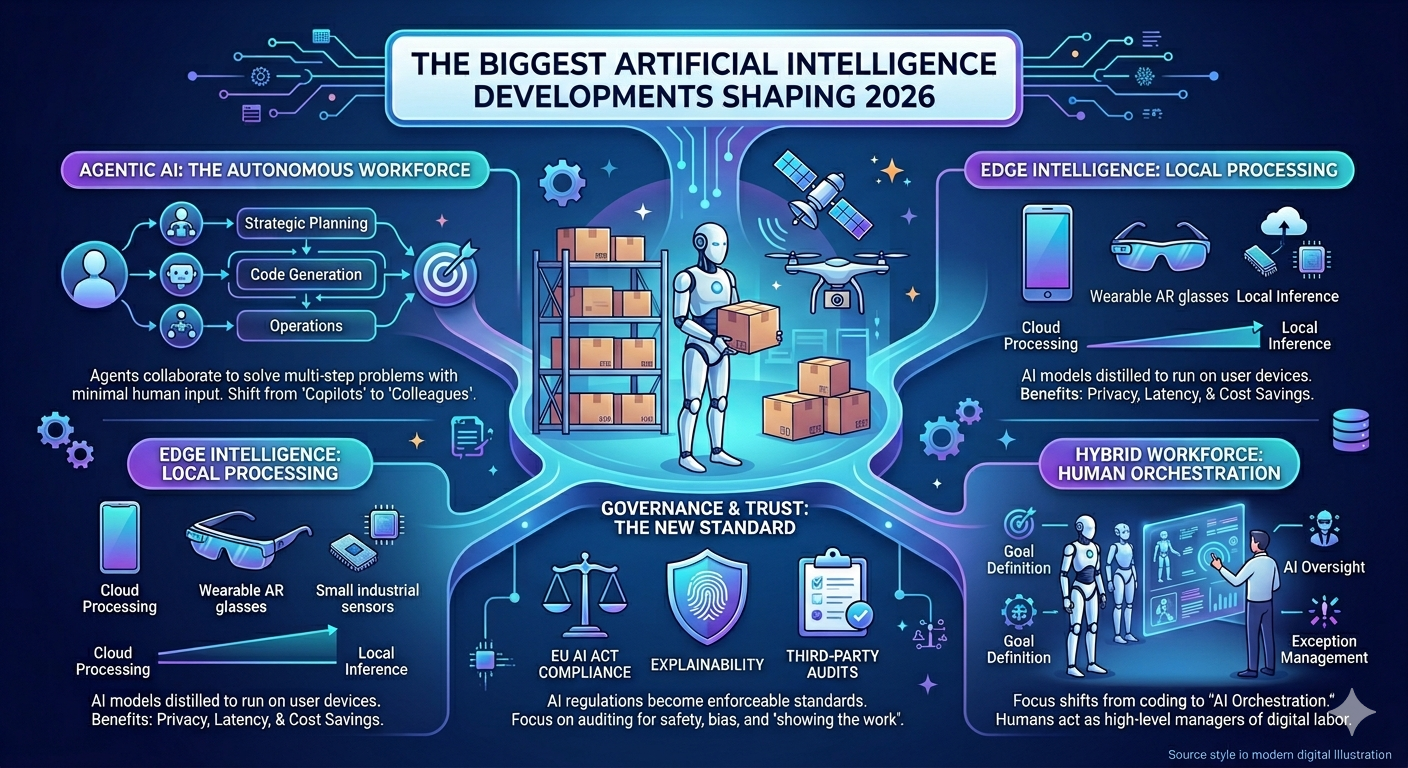
1. The Rise of Agentic AI: From “Copilots” to “Colleagues”
The most significant shift in 2026 is the transition from generative AI to
Agentic AI. For years, we used AI as a “copilot” to help us draft emails or write code.
Now, we use AI Agents—autonomous systems capable of planning, reasoning, and executing multi-step tasks without constant human hand-holding.
These agents don’t just suggest a travel itinerary; they book flights, negotiate with vendors for better corporate rates, and automatically file expense reports. In the enterprise world, businesses are deploying
Multi-Agent Systems (MAS) where specialized AI agents collaborate.
For example, a “Software Developer Agent” writes code, a “Security Agent” audits it in real-time, and a “DevOps Agent” deploys it to the cloud.
2. Physical AI: Giving Intelligence a Body
In 2026, AI has stepped out of the screen. We are seeing a massive surge in
Physical AI—the fusion of large-scale reasoning models with robotics.
Unlike rigid, pre-programmed robots of the past, today’s machines use embodied AI to learn through real-world and virtual experiences.
- Humanoid Workers: Factories and warehouses now deploy humanoid robots with human-like dexterity. They understand spatial context and handle unexpected situations like dropped items or blocked paths.
- Autonomous Logistics: Drone delivery is now a standardized urban utility. AI-driven smart grids and autonomous delivery networks have significantly reduced last-mile friction in supply chains.
3. Edge Intelligence and On-Device Processing
The “Cloud-First” era is being challenged by the Edge-First movement.
In 2026, smartphones, wearables, and industrial sensors run powerful AI models locally.
- Privacy: Sensitive data stays on-device.
- Latency: Real-time applications like AR and autonomous driving require instant processing.
- Cost: Reduces dependency on expensive centralized data centers.
4. The “Year of Truth” for AI Governance
2026 marks a regulatory turning point. The EU AI Act is now fully enforced, alongside similar frameworks globally. We have moved from suggested ethics to enforceable standards.
Organizations must now provide AI Explainability. If an AI system makes a decision—such as denying a loan or diagnosing a patient—it must clearly explain its reasoning. This has led to the rise of
Trust-as-a-Service, where third-party firms audit AI systems for safety, bias, and compliance.
5. AI-Driven Breakthroughs in Healthcare and Science
The real heroes of 2026 are Scientific Foundation Models, driving breakthroughs across industries:
- Predictive Medicine: AI analyzes genomic and wearable data to predict diseases like Alzheimer’s or kidney conditions years in advance.
- Hyper-Personalized Care: AI scribes automate documentation, reducing physician burnout and improving patient care.
- Climate Tech: AI-powered smart grids balance renewable energy supply with precision.
6. The New Workforce Reality: Hybrid Talent
The fear that AI will replace jobs has evolved.
AI is eating the software, but humans are still the chefs.
Developers are shifting from writing code to expressing intent. Instead of debugging, they orchestrate AI systems to build and maintain solutions. The most valuable skills in 2026 are
AI Orchestration and AI Governance.
We are becoming a workforce of “Human-in-the-Loop” managers, overseeing a digital labor force that handles both repetitive and complex tasks.
Looking Ahead
AI is becoming invisible—like electricity or the internet—powering daily life in the background. It manages our health, drives our systems, and supports our decisions without constant interaction.
The real question is no longer “Can AI do it?” but
“How do we ensure AI does it safely, fairly, and sustainably?”