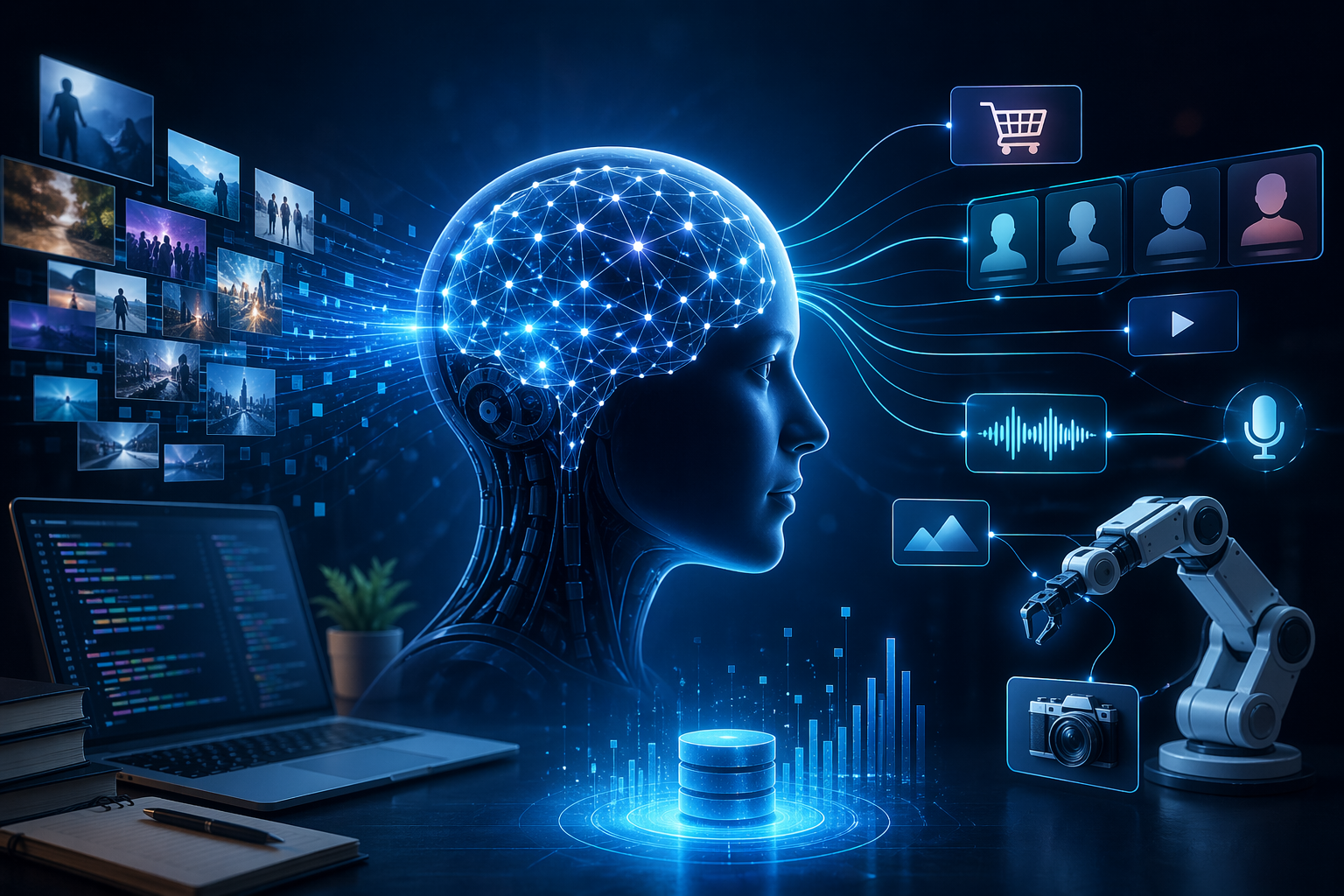
Artificial Intelligence (AI) can feel like magic. You type a question, and it answers. You upload a photo, and it recognizes faces. You watch a video, and suddenly the platform knows exactly what you want to watch next. But behind the scenes, AI isn’t magic at all—it’s a combination of math, data, and patterns working together at scale.
Let’s break it down in a way that finally makes it click.
1. AI Is Basically Pattern Recognition
At its core, AI is about recognizing patterns.
Think about how humans learn. If you see hundreds of pictures of cats, over time you start to notice patterns—whiskers, ears, shape, behavior. Eventually, you can identify a cat almost instantly.
AI works in a similar way, but instead of intuition, it uses data and mathematical models. You feed it thousands (or millions) of examples, and it learns patterns from that data.
For example:
- Show it many emails labeled “spam” or “not spam”
- It learns patterns in words, tone, and structure
- It can then classify new emails on its own
No “thinking” like a human—just pattern matching at a very advanced level.
2. Data Is the Fuel
AI doesn’t work without data. In fact, data is everything.
Imagine trying to teach someone a language without giving them any examples. Impossible, right? The same goes for AI.
The more high-quality data you give an AI system:
- The better it learns
- The more accurate it becomes
- The more useful it gets
This is why big companies invest heavily in collecting and organizing data. It’s not just about having AI—it’s about having the right data to train it.
3. Algorithms: The Brain Behind the Learning
If data is the fuel, algorithms are the engine.
An algorithm is simply a set of instructions that tells the AI how to learn from data. These instructions guide the system on:
- What patterns to look for
- How to adjust when it makes mistakes
- How to improve over time
One of the most common approaches is called machine learning, where the system learns from data instead of being explicitly programmed.
Instead of saying:
“If this happens, do that”
You say:
“Here are many examples—figure it out.”
4. Neural Networks: Inspired by the Human Brain
One of the most powerful types of AI models is called a neural network.
It’s inspired (loosely) by how the human brain works. Instead of neurons, you have layers of mathematical nodes that process information.
Here’s a simple way to imagine it:
- Input layer: receives raw data (like an image or text)
- Hidden layers: analyze patterns step by step
- Output layer: gives the final answer (like “cat” or “not cat”)
Each layer refines the data a little more, turning raw input into meaningful output.
Deep learning (a more advanced version) uses many layers—sometimes hundreds—to detect highly complex patterns.
5. Training: How AI Learns
AI doesn’t start smart. It becomes smart through training.
Training works like this:
- The AI makes a prediction
- It compares that prediction to the correct answer
- It calculates the error (how wrong it was)
- It adjusts itself slightly to improve
This process repeats thousands or millions of times.
Over time:
- Errors decrease
- Accuracy increases
- The model becomes better at its task
It’s like practicing a skill repeatedly until you get good at it.
6. Types of AI You Use Every Day
You might not realize it, but AI is already everywhere:
Recommendation Systems
These suggest what to watch, buy, or listen to based on your behavior.
Voice Assistants
They convert speech into text, understand it, and respond.
Image Recognition
Used in security systems, social media, and even healthcare.
Chatbots
They understand language and generate human-like responses.
All of these are built on the same core idea: learning patterns from data.
7. AI Doesn’t “Understand” Like Humans
Here’s an important reality check.
AI doesn’t truly understand things the way humans do. It doesn’t have emotions, consciousness, or real-world awareness.
It:
- Predicts likely answers
- Recognizes patterns
- Mimics human responses
But it doesn’t “know” things in a human sense.
For example, if an AI writes a perfect essay about emotions, it’s not feeling anything—it’s just predicting what words should come next based on patterns it has learned.
8. Why AI Feels So Smart
AI feels intelligent because:
- It processes massive amounts of data quickly
- It finds patterns humans might miss
- It improves continuously with more data
Also, modern AI systems are trained on diverse datasets, which allows them to handle a wide range of tasks—from writing to coding to analyzing images.
This versatility makes it seem like a general intelligence, even though it’s still fundamentally pattern-based.
9. The Limitations You Should Know
AI is powerful, but it’s not perfect.
Some key limitations:
- Bias: If training data is biased, AI will reflect that bias
- Errors: It can produce incorrect or misleading outputs
- Lack of context: It may miss nuance or deeper meaning
- Dependence on data: Poor data leads to poor results
Understanding these limits helps you use AI more effectively—and responsibly.
10. The Simple Way to Remember It
If everything still feels abstract, here’s the simplest way to think about AI:
AI = Data + Patterns + Learning from Mistakes
That’s it.
- Data gives it examples
- Algorithms help it learn patterns
- Training improves it over time
Everything else—chatbots, recommendations, image recognition—is just an application of this core idea.
Final Thoughts
AI isn’t magic. It’s not human. And it’s not mysterious once you break it down.
It’s a tool—an incredibly powerful one—that learns from data, identifies patterns, and improves through repetition.
The more you understand how it works, the better you can use it—whether you’re building a business, studying, or simply trying to keep up with a rapidly changing world.
And once it clicks, you stop seeing AI as something futuristic—and start seeing it as something practical, usable, and already part of your everyday life.