From autonomous agents to artificial general intelligence — the next five years will redefine how humanity works, creates, and connects.
$1.8T
800M
40%
AI market by 2030 (Goldman Sachs)
jobs impacted globally (McKinsey)
global productivity uplift potential
Artificial intelligence is no longer a distant promise — it is an accelerating present reshaping every industry. But the leap from 2026 to 2030 may be the most consequential in the technology’s history. Here’s what leading researchers, economists, and technologists actually expect.
The rise of autonomous AI agents
Today’s AI tools answer questions. By 2030, AI agents will execute multi-step workflows autonomously — browsing the web, writing code, scheduling meetings, negotiating contracts, and managing entire business pipelines without human intervention at each step.
Companies like Google DeepMind, Anthropic, and OpenAI are already deploying early agent frameworks. The defining shift will be persistent memory and tool use at scale — agents that remember your preferences across sessions, learn your working style, and operate across interconnected digital environments.
“AI agents will become the new workforce layer — not replacing humans entirely, but dramatically amplifying what a single person can accomplish.”
— Dario Amodei, CEO of Anthropic, 2025
Healthcare: the biggest beneficiary
AI is poised to compress decades of medical research into years. By 2030, expect AI-designed drugs reaching clinical trials in months rather than years, diagnostic models detecting cancer from imaging with superhuman accuracy, and personalized treatment protocols generated in real time from your genetic data.
Drug discovery
AlphaFold-class models are already predicting protein structures. By 2030, AI will design novel therapeutics end-to-end.
Diagnostic AI
FDA-approved AI diagnostics already outperform radiologists in specific tasks. Mass deployment begins 2027–2028.
Personalised medicine
Genomic + lifestyle data fed into AI models will produce treatment plans tailored to individual biology.
Mental health tools
AI therapists and early-warning systems for crisis detection are moving from research to regulated clinical tools.
The AGI question: closer than you think?
Artificial General Intelligence — AI that matches or exceeds human performance across all cognitive tasks — remains the most debated milestone in tech. A 2025 survey of leading AI researchers found that 50% believe AGI will arrive before 2040, with a meaningful cluster predicting 2028–2032.
What’s more certain is the emergence of “narrow-broad” systems: models that aren’t AGI by strict definition, but perform at expert level across dozens of domains simultaneously. These systems will power the next wave of economic disruption — and opportunity.
Pro Insight — Investor Intelligence
Where to watch: The real AGI race isn’t just OpenAI vs Google. It’s the infrastructure layer — compute, memory architecture, and energy. NVIDIA, TSMC, and emerging photonic chip companies (like Lightmatter) are critical chokepoints.
Key risk: Regulatory intervention. The EU AI Act (2024) and anticipated US AI legislation by 2027 will impose compliance costs that could advantage incumbents and create significant moats — or stifle experimentation.
Signal to watch: When a frontier AI lab publicly discloses an internal AGI evaluation framework with passing scores, that’s the moment markets will reprice every AI-adjacent sector simultaneously.
A realistic AI roadmap to 2030
2026 — Now
Multimodal AI becomes default
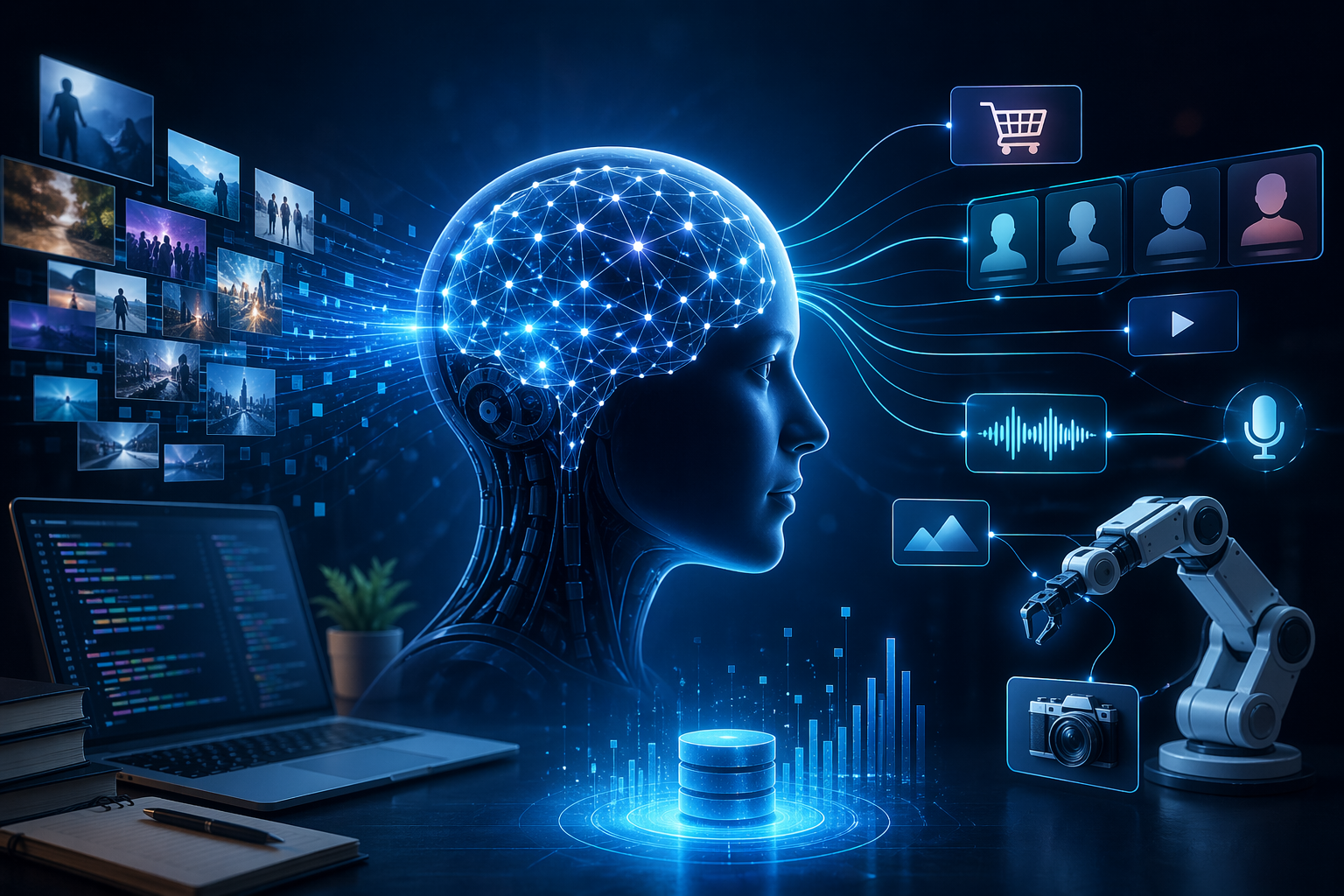
Text, image, audio, and video understanding unified in single models. Voice AI interfaces mainstream.
2027
Autonomous agents at enterprise scale
Fortune 500 companies operate AI agent teams handling finance, legal, and HR workflows end-to-end.
2028
AI regulation matures globally
US federal AI law enacted. China’s AI governance framework fully operational. International standards emerge.
2029
Scientific AI breakthroughs accelerate
First AI-designed drug approved by FDA. AI-assisted fusion energy milestone reached.
2030
The intelligence economy
AI contributes an estimated $15.7 trillion to global GDP (PwC). A new class of human-AI collaborative roles dominates white-collar work.
The workforce transformation
Contrary to catastrophist narratives, the most credible economic research suggests AI will transform jobs more than eliminate them — at least in the short term. McKinsey estimates up to 800 million workers will need to adapt their skill sets by 2030, but new roles in AI oversight, prompt engineering, AI training data curation, and human-AI collaboration management are already emerging.
The workers most at risk are those in repetitive cognitive tasks — data entry, basic coding, routine legal review, and customer service. The workers with the strongest AI-era advantage combine domain expertise with AI literacy — the ability to direct, audit, and iterate with AI tools effectively.
Ethics, safety, and the governance race
The single greatest uncertainty in AI’s trajectory to 2030 is not technical — it’s political. Who controls the most powerful AI systems, and under what rules? The US, EU, China, and UK are each pursuing divergent regulatory philosophies, creating a fragmented global landscape.
On the safety front, interpretability research — understanding why AI models produce specific outputs — is advancing rapidly. Anthropic, DeepMind, and academic labs have made significant progress in mechanistic interpretability. By 2030, regulators may require interpretability audits for high-stakes AI deployments in finance, healthcare, and criminal justice.
The bottom line
By 2030, AI will not be a product category — it will be infrastructure. Like electricity or the internet, its presence will be assumed and its absence will be the exception. The organisations, governments, and individuals who understand this shift now — and invest in AI literacy, governance, and strategic deployment — will define the next era of global leadership.
The future of AI is not something that will happen to us. It is something we are actively building — decision by decision, policy by policy, model by model.