The Human Element: Why We Need AI
To understand why AI is necessary, we must look at the sobering reality of manual driving. Over 90% of road accidents are caused by human error—distraction, fatigue, impairment, or simple misjudgment. Humans have limited fields of vision and reaction times that average around 1.5 seconds.
In contrast, AI-driven systems operate with 360-degree perception and sub-millisecond reaction speeds. By removing the “human factor,” we aren’t just making driving more convenient; we are solving a global public health crisis.
1. The Brain of the Machine: How Autonomous Vehicles Work
Autonomous vehicles (AVs) rely on a complex “sensor fusion” to navigate the world. This isn’t just a car with a GPS; it’s a mobile supercomputer.
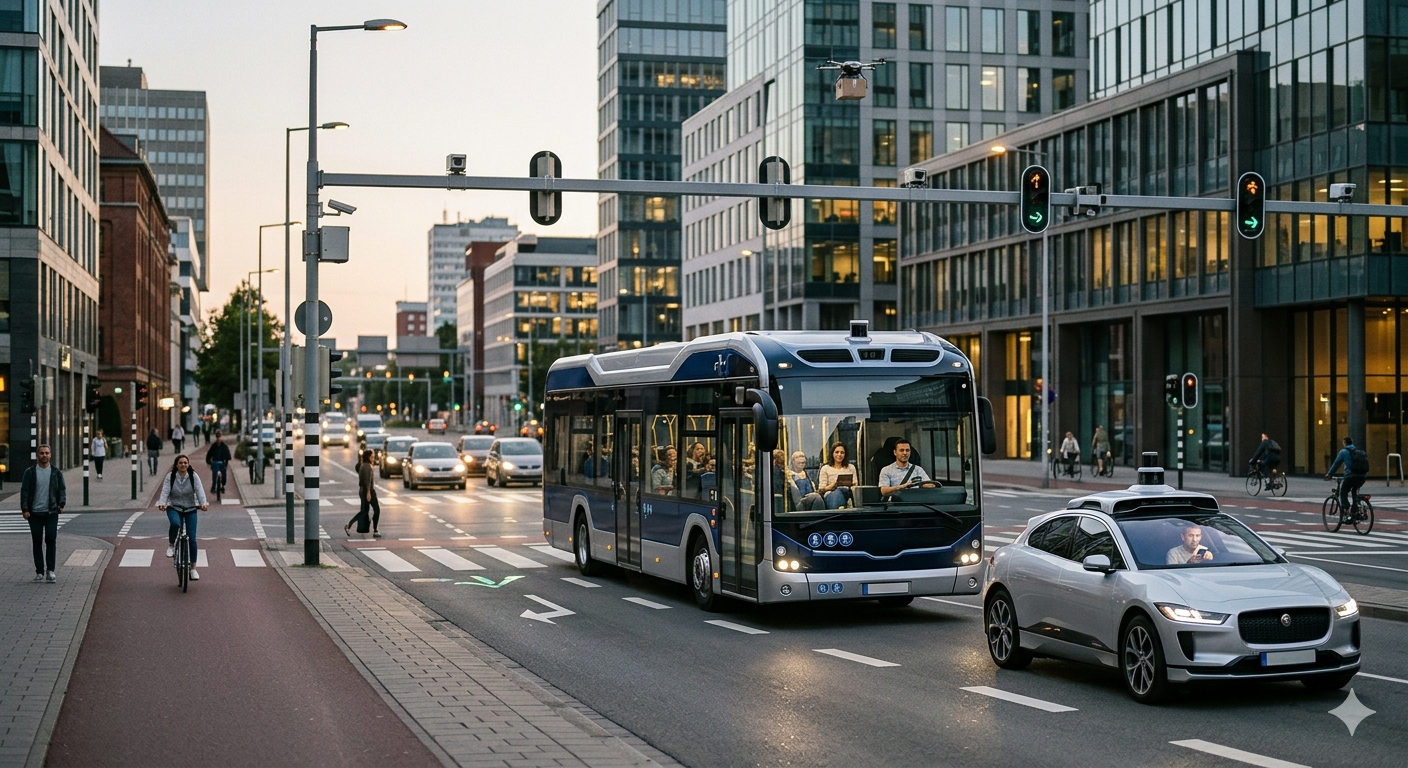
Computer Vision: Using LiDAR, Radar, and high-resolution cameras, AI interprets visual data to identify pedestrians, cyclists, and debris.
Predictive Modeling: AI doesn’t just see a ball rolling into the street; it predicts that a child might be running after it, slowing the vehicle before the hazard even appears.
Path Planning: Algorithms calculate the most efficient and safest route in real-time, adjusting for sudden lane closures or weather changes.
Through Deep Learning, these vehicles “learn” from billions of miles of simulated and real-world driving data, becoming more adept at handling “edge cases”—those rare, unpredictable road scenarios that often baffle human drivers.
2. Beyond the Car: AI Traffic Management Systems
While self-driving cars are impressive, the real magic happens when the entire city starts “talking.” AI Traffic Management (AITM) transforms static roads into dynamic, living networks.
Smart Intersections
Traditional traffic lights operate on fixed timers. AI-powered intersections use cameras and sensors to monitor real-time traffic flow. If no cars are coming from the north, the system keeps the eastbound light green, reducing unnecessary idling. This “Green Wave” technology can reduce commute times by up to 25%.
V2X Communication
The future of safety lies in Vehicle-to-Everything (V2X) communication. In this ecosystem:
V2V (Vehicle-to-Vehicle): Two cars approaching a blind intersection can “warn” each other of their presence.
V2I (Vehicle-to-Infrastructure): A bridge can alert an oncoming car that its surface is icing over.
V2P (Vehicle-to-Pedestrian): A car can detect a smartphone signal behind a parked van, alerting the driver (or the AI) to a hidden pedestrian.
3. Slashing Accidents and Saving Lives
The primary promise of AI in transport is the Vision Zero initiative—the goal of reaching zero road fatalities.
Key Stat: Researchers suggest that widespread adoption of autonomous vehicles could reduce traffic fatalities by up to 94%, potentially saving hundreds of thousands of lives annually.
AI reduces accidents through:
Eliminating Distraction: AI never looks at a text message or gets drowsy.
Precision Maneuvering: In emergency situations, AI can perform “evasive steering” or “automatic emergency braking” with a level of precision a human foot simply cannot match.
Cooperative Driving: Imagine a highway where cars travel in “platoons”—inches apart at high speeds. Because they are digitally linked, if the lead car brakes, every car in the chain brakes simultaneously, eliminating the “accordion effect” that causes multi-car pileups.
4. The Environmental and Economic Ripple Effect
AI-driven transport isn’t just about safety; it’s about sustainability.
Reduced Emissions: AI optimizes acceleration and braking (eco-driving), which can improve fuel and battery efficiency by 15%.
Smaller Footprints: As ride-sharing autonomous fleets become the norm, the need for massive downtown parking lots will vanish, freeing up urban space for parks and housing.
Economic Productivity: When the “driver” becomes a “passenger,” commute time turns into work time or rest time. The global economy stands to gain billions in reclaimed productivity.
The Road Ahead: Challenges to Overcome
Despite the momentum, the path isn’t entirely clear. We still face significant hurdles:
Regulatory Frameworks: Who is liable in an AI-controlled accident? Lawmakers are still racing to catch up with the technology.
Cybersecurity: As vehicles become nodes on a network, protecting them from hacking is a top priority.
Public Trust: Transitioning from being “in control” to trusting a line of code is a psychological leap for many.
Conclusion
The revolution of autonomous vehicles and AI traffic management is a transition from reactive to proactive safety. We are moving away from a world where we hope drivers pay attention, toward a world where the infrastructure itself ensures no one gets hurt.
As AI continues to evolve, the “commute” will transform from a daily chore into a seamless, safe, and productive part of our lives. The driver’s seat may eventually become optional, but the destination—a world with fewer accidents and cleaner air—is one we should all be eager to reach.