The buzz around agentic AI in ecommerce is everywhere. From autonomous shopping assistants to AI-driven purchasing decisions, many believe we are on the verge of a major transformation in how people buy online.
But not everyone is convinced.
Dell Technologies offers a refreshingly grounded perspective. Instead of jumping on the hype, Dell is taking a practical, data-driven approach—one that suggests the real power of agentic AI lies not in commerce itself, but in search and discovery.
Let’s break down what this means and why it matters for the future of ecommerce.
The Reality Check: Agentic AI Is Growing, But Not Transforming (Yet)
There’s no denying that AI platforms like ChatGPT, Perplexity, and Claude are sending more traffic to ecommerce websites. Dell has observed this increase firsthand.
However, according to Dell’s leadership, the impact is still far from revolutionary.
While traffic from AI sources is rising, it hasn’t yet translated into a dramatic shift in purchasing behavior. Customers are not suddenly handing over decision-making to AI agents and letting them shop autonomously at scale.
This gap between expectation and reality is important.
It shows that while agentic AI has potential, its current role is still evolving—not dominating.
Search Is the Real Battlefield
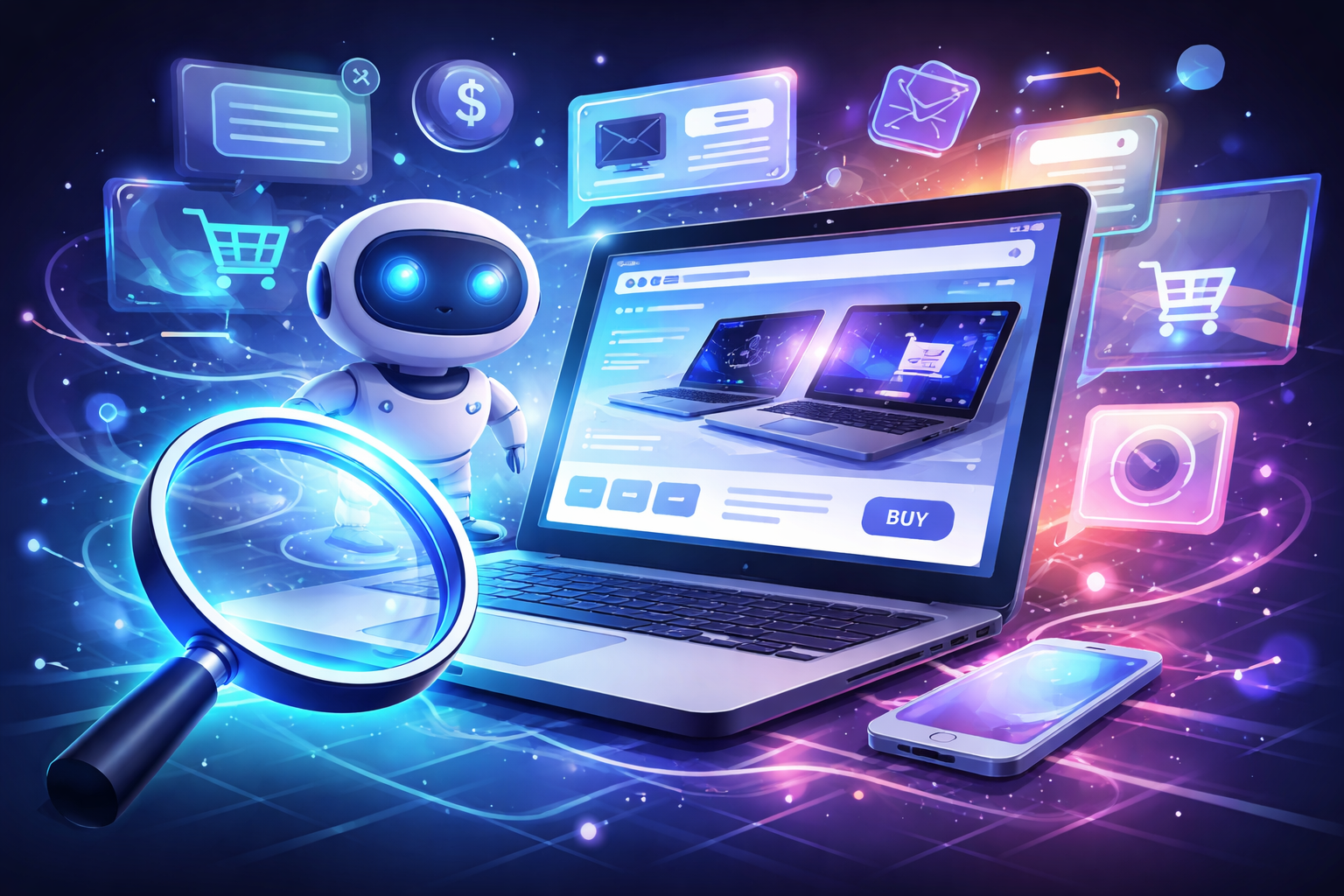
If there’s one area where agentic AI is already making a difference, it’s search.
Dell emphasizes a simple but powerful truth:
If customers can’t find what they’re looking for quickly, they leave.
This is where agentic AI shines today.
Instead of acting as a full shopping replacement, AI tools are becoming:
- Smart product discovery engines
- Cross-platform recommendation systems
- Intelligent search assistants
In other words, AI is improving how users find products, not necessarily how they complete purchases.
Why Agentic Shopping Isn’t Taking Over (Yet)
One of the biggest reasons agentic commerce hasn’t exploded is product complexity.
Dell sells highly configurable products like laptops and desktops. Buying these isn’t a one-click decision. Customers need to:
- Compare specifications
- Understand performance differences
- Customize configurations
- Evaluate pricing vs. value
This kind of buying journey requires exploration and learning, something AI agents are not fully equipped to replace today.
Even when users arrive via AI platforms, their behavior doesn’t change much—they still browse, compare, and evaluate before purchasing.
👉 The takeaway:
Customer behavior is driven more by the product than the traffic source.
Agentic AI as an Aggregator, Not a Disruptor
A more realistic way to view agentic AI is as an aggregation layer.
Think about how platforms like:
- DoorDash
- Uber Eats
- Instacart
changed consumer behavior.
They didn’t reinvent commerce—they simplified access.
Similarly, agentic AI is likely to:
- Aggregate product options
- Compare alternatives
- Refer traffic to ecommerce sites
Rather than replacing ecommerce websites, it will sit on top of them, guiding users toward decisions.
How Big Tech Is Shaping This Shift
Major ecommerce and technology platforms are already adapting to this new reality:
- Shopify is integrating AI-driven discovery and enabling shopping within conversational interfaces
- Salesforce is enhancing AI-powered search capabilities
- Algolia is advancing intelligent search experiences
These developments reinforce the same idea:
👉 Search and discovery are the first—and most important—AI use cases in ecommerce.
What This Means for Ecommerce Businesses
If you’re running an ecommerce business, Dell’s perspective offers clear guidance:
1. Invest in Search First
Your search experience matters more than ever:
- Fast, accurate results
- AI-friendly product data
- Strong filtering and recommendations
2. Optimize for AI Discovery
AI platforms are becoming new traffic sources:
- Structure your product data properly
- Focus on clarity and relevance
- Make your catalog easy for AI to interpret
3. Don’t Overestimate Automation
Fully autonomous shopping is not mainstream yet.
Focus on assisting users, not replacing them.
4. Understand Your Product Type
- Simple products → higher potential for agentic purchases
- Complex products → require guided experiences
The Future: Evolution, Not Explosion
Agentic AI is not a sudden disruption—it’s a gradual evolution.
Short Term
- Increased AI-driven traffic
- Better search experiences
Medium Term
- Deeper integration between AI and ecommerce platforms
- Smarter recommendations and personalization
Long Term
- Hybrid shopping experiences combining human decisions with AI assistance
Final Thoughts
Dell’s approach cuts through the noise.
Instead of chasing hype, it focuses on real user behavior and practical application.
And the conclusion is clear:
👉 Agentic AI is transforming how people discover products—not how they buy them (yet).
For now, the winners in ecommerce won’t be those who automate everything—but those who make it effortless for customers to find what they need.
Source & Credit
This blog is based on insights and reporting from Digital Commerce 360, featuring commentary from Breanna Fowler, Head of Global Consumer Revenue Programs at Dell Technologies.