


















Artificial Intelligence is no longer an experimental technology reserved for innovation labs. Across industries, AI has become a strategic business driver that is transforming customer experience, operational efficiency, and revenue growth. According to a global study conducted by Google Cloud and National Research Group involving 3,466 senior executives worldwide, organizations are rapidly shifting from asking whether AI works to determining how quickly they can scale it.
The report, “The ROI of AI in Customer Experience,” highlights how AI agents are delivering measurable returns across industries including retail, healthcare, telecommunications, manufacturing, and financial services.
The Rise of AI Agents in Customer Experience
Modern AI agents are far more advanced than traditional chatbots. These systems are powered by large language models (LLMs) and can reason, plan, interact autonomously, and access enterprise systems through APIs and integrated tools.
Today’s customers expect intelligent, personalized, and seamless experiences. Businesses are responding by integrating AI agents into customer journeys, websites, mobile applications, service centers, and digital commerce platforms. According to the study:
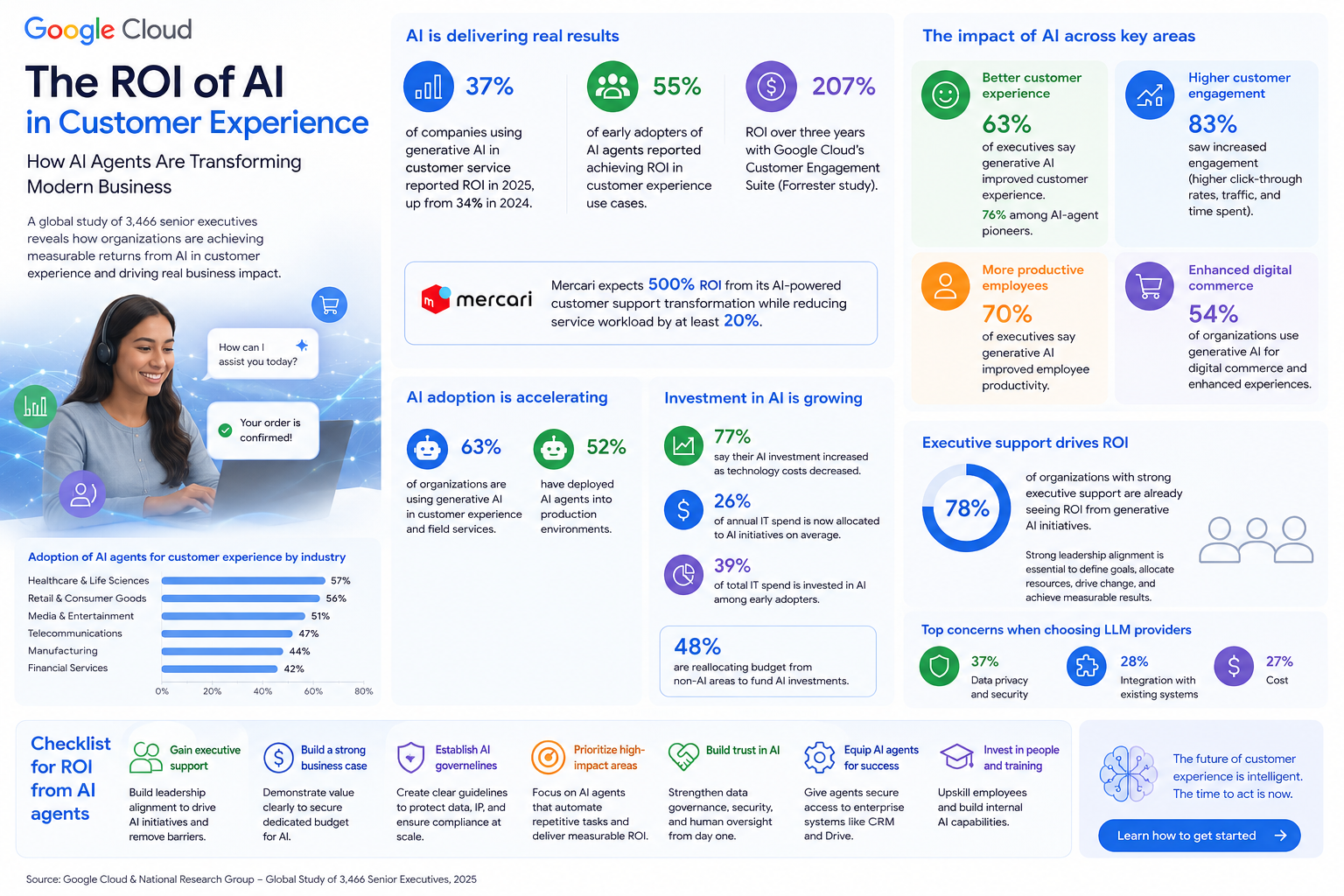
- 63% of executives say their companies already use generative AI in customer experience and field services.
- 52% of organizations have already deployed AI agents into production environments.
- 88% of early adopters of AI agents are already seeing positive ROI from generative AI investments.
This shift demonstrates that AI is moving from theory into practical, enterprise-wide implementation.
AI Is Delivering Real Financial Returns
One of the strongest findings from the report is that companies are already generating measurable financial gains through AI adoption.
The study revealed that:
- 37% of companies using generative AI in customer service reported direct ROI in 2025, up from 34% in 2024.
- Among organizations that are early adopters of AI agents, 55% reported achieving ROI in customer experience use cases such as call centers, chat systems, and technical support.
- An independent Forrester study found that Google Cloud’s Customer Engagement Suite generated a 207% ROI over three years, with a payback period of less than six months.
Companies are seeing cost savings through automation while also increasing customer engagement and revenue opportunities.
For example, Mercari, Japan’s largest online marketplace, expects a 500% ROI from its AI-powered customer support transformation while reducing service workload by at least 20%.
AI Improves Customer Satisfaction and Engagement
Beyond financial gains, AI is significantly enhancing customer satisfaction and personalization.
The report highlights that:
- 63% of executives said generative AI improved customer experience.
- Among AI-agent pioneers, that number rises to 76%.
- 83% of executives observed increased user engagement, including higher click-through rates, traffic, and time spent on websites.
- 51% reported customer experience improvements between 6–10%.
AI agents are enabling hyper-personalized and conversational interactions that create stronger customer relationships. Businesses can now provide contextual recommendations, faster responses, and seamless omnichannel support.
Telecommunications giant Verizon explained that AI-powered customer engagement tools helped reduce call durations while improving personalization and long-term customer loyalty.
AI Is Making Employees More Productive
AI is not replacing human employees—it is enhancing their capabilities.
Generative AI is automating repetitive administrative tasks such as:
- Data entry
- Ticket categorization
- Call summarization
- Customer query routing
- Follow-up email creation
As a result, customer service representatives can focus on higher-value conversations requiring empathy and critical thinking.
According to the report:
- 70% of executives said generative AI improved employee productivity.
Real-world examples further validate these gains. Mr. Cooper, a major mortgage servicing company, used Google AI to improve average handling time by 3.53% across 500,000 monthly calls, saving approximately 28,000 work hours annually.
Similarly, Best Buy emphasized that AI tools reduce cognitive load for service agents, enabling them to focus more on building personal customer connections.
AI Is Transforming Digital Commerce
AI is reshaping the way customers discover products and interact with digital platforms.
Traditional keyword-based searches are being replaced by conversational AI-powered discovery systems that understand customer intent and provide personalized recommendations.
The study found that:
- 54% of organizations already use generative AI for digital commerce and enhanced customer experiences across web, mobile, and kiosks.
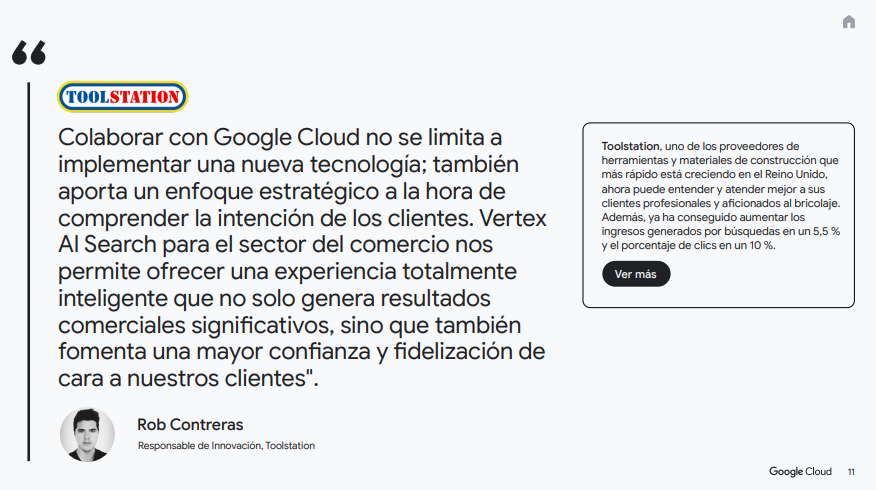
Retail company Toolstation reported impressive outcomes after implementing Google Cloud AI solutions:
- 5.5% increase in search-generated revenue
- 10% increase in click-through rates
These results demonstrate how AI-powered commerce experiences can directly influence purchasing behavior and customer loyalty.
Industry-Wide Adoption Is Accelerating
AI adoption is spreading rapidly across sectors, though each industry prioritizes different use cases.
According to the report, adoption rates of AI agents for customer experience include:
- Healthcare & Life Sciences: 57%
- Retail & Consumer Goods: 56%
- Media & Entertainment: 51%
- Telecommunications: 47%
- Manufacturing: 44%
- Financial Services: 42%
Financial institutions, for example, prioritize secure and efficient interactions, while retailers focus on managing large volumes of customer queries and improving shopping journeys.
Commerzbank’s AI assistant “Bene” now handles more than 2 million chats and successfully resolves 70% of customer inquiries.

Investment in AI Continues to Grow
Organizations are increasing AI spending despite declining technology costs.
The study shows:
- 77% of executives said their AI investment increased as technology costs decreased.
- Companies now allocate an average of 26% of annual IT spending to AI initiatives.
- Early AI adopters invest as much as 39% of total IT spending into AI.
Organizations are also prioritizing:
- Data quality improvement
- AI governance and risk management
- Employee AI training
- Cross-functional collaboration
- AI agent deployment
This indicates that companies now view AI as a long-term strategic investment rather than a short-term experiment.
Executive Support Is Critical for Success
The report strongly emphasizes the importance of executive leadership in successful AI adoption.
Organizations with strong executive alignment are significantly more likely to achieve measurable ROI:
- 78% of companies with strong executive support reported ROI from generative AI initiatives.
Leadership teams play a crucial role in:
- Defining AI objectives
- Aligning AI with business goals
- Allocating resources and budgets
- Driving organizational change
- Establishing governance frameworks
Without strategic direction from leadership, AI initiatives often struggle to scale effectively.
Challenges Still Remain
Despite rapid adoption, businesses continue to face important challenges in implementing AI responsibly.
The top concerns when selecting AI and LLM providers include:
- Data privacy and security (37%)
- Integration with existing systems (28%)
- Cost (27%)
Organizations must therefore build strong governance, compliance, and cybersecurity frameworks alongside their AI strategies.
Conclusion
The findings from Google Cloud’s global study make one thing clear: AI is already generating measurable business value.
From improving customer satisfaction and employee productivity to increasing operational efficiency and revenue growth, AI agents are transforming the future of customer experience. Companies that invest early, align AI with strategic objectives, and build strong governance frameworks are achieving the strongest returns.
As AI technology continues to evolve, businesses that embrace intelligent customer engagement today will likely become tomorrow’s market leaders.
The era of AI-powered customer experience is no longer approaching—it has already arrived.
Insights Credit – services.google.com