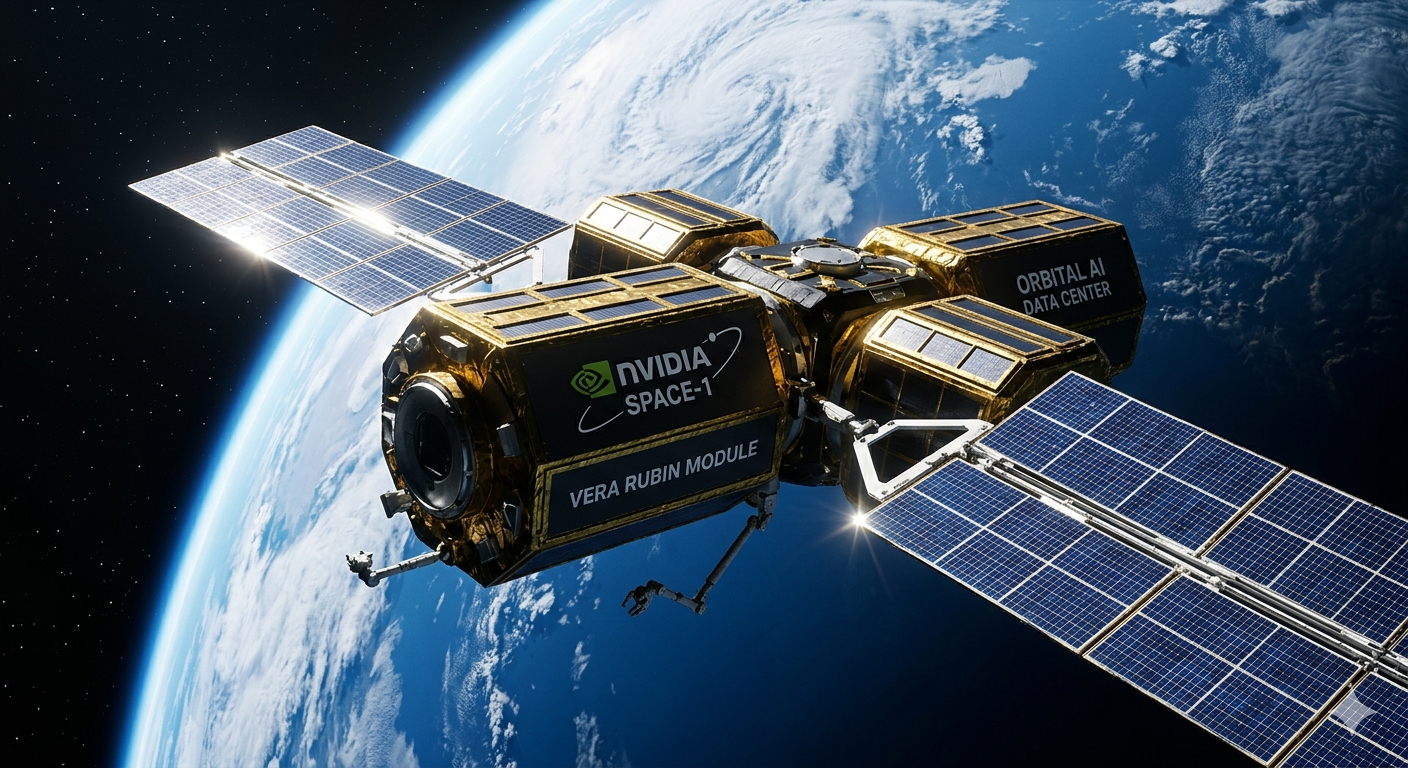
Beyond the Atmosphere: Nvidia Unveils the “Space-1 Vera Rubin” for Orbital AI Data Centers
The “cloud” is about to become a literal description. At the GTC 2026 conference, Nvidia CEO Jensen Huang stood before a capacity crowd to announce the company’s most ambitious infrastructure play to date: taking high-performance AI compute into Earth’s orbit. With the unveiling of the Space-1 Vera Rubin Module, Nvidia has officially signaled that the next frontier for the AI industrial revolution isn’t on land, but in the stars.
The Hardware: Engineering for the Void
Named after the legendary astronomer who discovered dark matter, the Space-1 Vera Rubin Module is a feat of extreme engineering. Unlike terrestrial GPUs, which rely on massive fans or liquid cooling loops, the Space-1 is designed for the harsh reality of the vacuum.
Built on the cutting-edge Rubin GPU architecture, the module delivers a staggering 25x increase in AI inference performance compared to the space-hardened H100 tests of 2024. To achieve this in a “SWaP” (Size, Weight, and Power) constrained environment, Nvidia utilizes LPDDR5X memory for peak energy efficiency and a custom radiation-hardened chassis. This allows the chips to withstand high-energy cosmic rays that would typically “flip bits” and crash a standard server on Earth.
The Energy Crisis: Why Orbit is the Answer
The primary driver behind this shift is the terrestrial “Thermal Wall.” As of early 2026, the International Energy Agency (IEA) reports that global data center energy consumption has exceeded 1,000 TWh—roughly equivalent to the total power consumption of Japan. In many regions, local power grids have reached a breaking point, leading to moratoriums on new data center construction.
Space offers two “free” resources that are becoming impossibly expensive on Earth:
-
Infinite Solar Power: Satellites in Sun-Synchronous Orbit (SSO) have nearly 24/7 access to high-intensity solar radiation, unaffected by the atmosphere or weather.
-
Radiative Cooling: In the vacuum of space, heat cannot be moved by air. Instead, it must be radiated away. While this is an engineering challenge, the ambient temperature of deep space ($-270\text{°C}$) provides a massive thermal sink that requires zero water consumption—a stark contrast to the millions of gallons of fresh water used annually by land-based facilities.
Real-Time Intelligence: Edge Computing at 17,000 MPH
Beyond sustainability, the Space-1 module solves a massive data bottleneck. Currently, Earth-observation satellites capture petabytes of data, but only a fraction can be “downlinked” to ground stations due to limited bandwidth.
With the Vera Rubin module, satellites become Orbital Data Centers (ODCs). They can process raw imagery, detect a wildfire or a methane leak, and send only the critical “alert” back to Earth in milliseconds. Partners like Planet Labs and Aetherflux are already integrating these modules to move from “capturing data” to “generating insights” in real-time.
The 2026 Space Race: Who Else is in Orbit?
Nvidia’s announcement has accelerated an already heated competition. While Nvidia provides the “picks and shovels” (the chips), other giants are building the “mines”:
-
SpaceX & xAI: Elon Musk’s recent merger of satellite and AI interests aims to deploy a “Mega-Constellation” of compute-heavy satellites.
-
Axiom Space: The commercial space station leader is working on “Orbital Data Vaults”—secure, sovereign data centers that sit outside traditional national jurisdictions.
-
Starcloud: This startup recently successfully operated the first standalone GPU cluster in orbit, proving that training small-scale models in space is no longer a theory.
The Skeptics: Is This “Peak Insanity”?
Not everyone is convinced. Analysts from Gartner have labeled the concept of large-scale orbital data centers as “unrealistic” for the near term, citing the massive carbon footprint of rocket launches and the difficulty of hardware maintenance. “If a chip fails in Virginia, you send a technician,” one analyst noted. “If a chip fails in orbit, you have a multi-million dollar piece of space junk.”
Nvidia’s response is a move toward Modular On-Orbit Servicing. By designing the Space-1 modules to be swappable by robotic arms (like those on the ISS), they envision a future where orbital racks are upgraded rather than discarded.
Conclusion: A Hybrid Future
We are likely entering a “Hybrid Cloud” era. While massive LLM training will remain on Earth for the foreseeable future, the “inference” and “agentic” layers of AI are heading upward. The Space-1 Vera Rubin isn’t just a new product; it is the first building block of a decentralized, off-planet infrastructure that could finally decouple AI’s growth from Earth’s limited resources.